Writing a Resume
Example of mine. Yes it always needs work: resumeLB
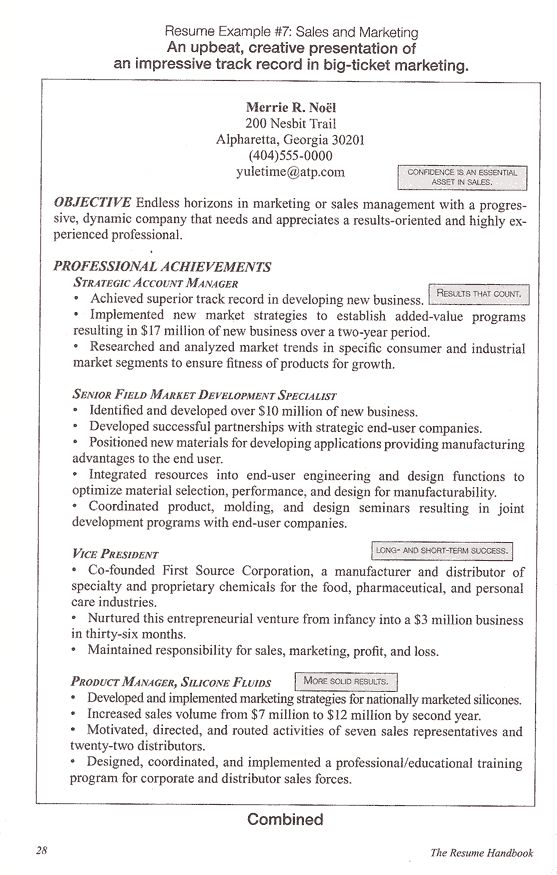
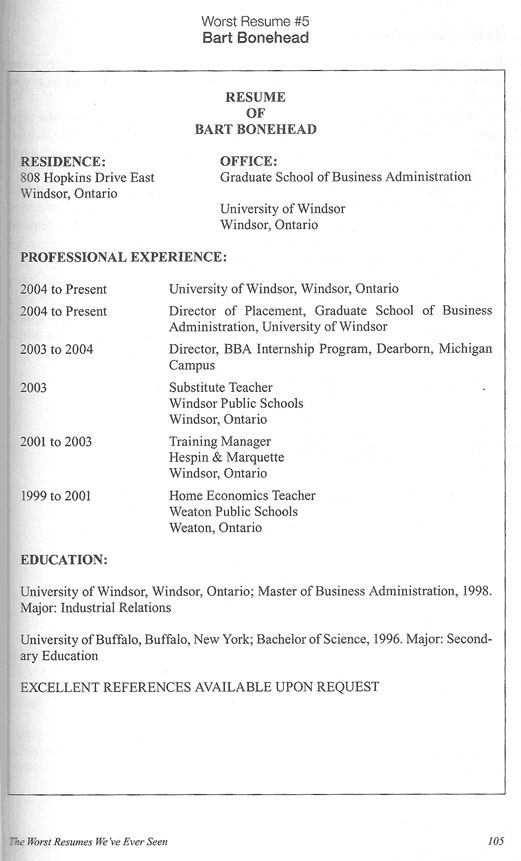
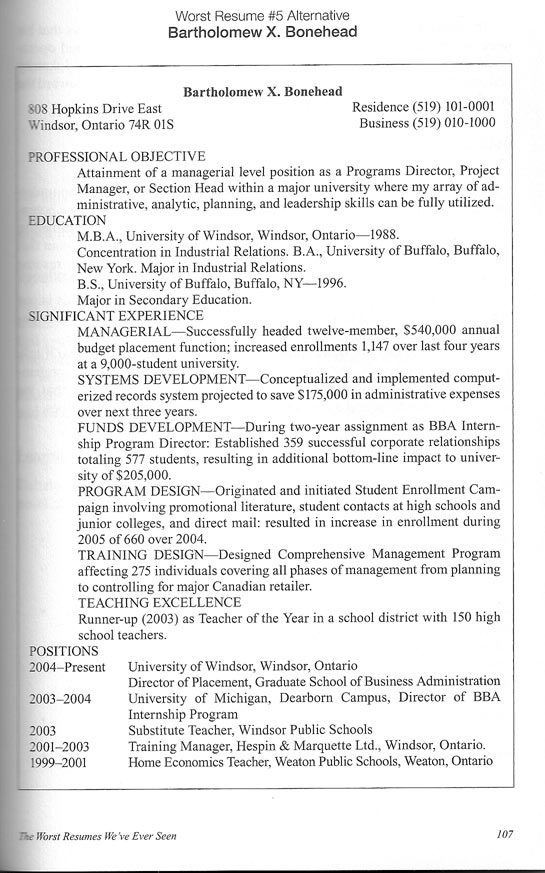
Some great sample resumes from The Resume Handbook by Arthur D.
Rosenberg:
resume
1, resume
2, resume 3, resume 4
resume
5 (bad resume)
resume5b (fixed bad
resume)
Basic layout:
TOP: Name, address, phone, website address, email
NEXT: Objective (This is unfamiliar to me as a studio artist, but is a possibility on designers resumes. You decide if this will help you)
NEXT: Education (Some people put this on the bottom. Put it on top if it is your best asset.)
NEXT: Awards (other possible titles: "Notable Achievements" or "Honors
and Awards")
NEXT: Skills (other possible titles: "Specialized Skills" or "Relevant Skills")
NEXT: Publications (have you been written about?)
NEXT: Additional professional activities. Did you lecture anywhere? (other possible titles: "Guest Lectures" if you have a bunch)
NEXT: Professional Experience (other possible titles: "Professional History" or "Experience". Do not use "Employment History" or "Work History". It looks pathetic and sad)
NEXT: Professional Affiliations (other possible titles: "Affiliations") This could also go above the professional experience section, but I usually put it after.
BOTTOM: "References available upon request" in italics and centered at bottom
Sample of a designers resume:
Designer Resume Template
Charles Lucas
266 Coldspring Rd.
Atlanta, GA 31196
(271) 555-8217
clucas@earthlink.net
__________________
Objective
To obtain a position with a strong, forward thinking, progressive company were
I can fully utilize my knowledge and experience as a designer.
Notable Achievements
- 1997: Awarded Special Mention Prize. "ICSID/ Compiegne Industrial Design
Award", France, for co-design of a "Portable Office Project".
- Guest Lecturer, Industrial Design, University of Georgia.
Relevant Skills
- Certified in CAD and in Architectural Drafting.
- Human Factor for product design.
- Human computer interface design.
- CDRS(Pro/Designer), Pro/E, TDI, AutoCAD, Form Z, Strata 3D, Infini-D, Corel
Draw, Adobe Photoshop, QuarkXPress, Adobe Illustrator, HyperCard, Persuasion,
MM Director.
Professional Experience
Harris Technologies, Atlanta, GA
Product Designer, 1998 - Present
Developed critical transmissions, performance monitoring, and diagnostics firmware
(C, ASM) for broadband hybrid fiber/coax telecommunications network (TDMA receiver/transmitter).
Documented interface/design and maintained MR ("modification request")
handling/response.
A & S Industries, Augusta, GA
Manager, Telephone Products Division / Manager, Advanced Product Design, 1994
- 1998
Hired as manager of Telephone Products, and later promoted to manager of Advanced
Product Design, I was responsible for all new product design. Provided key
technology enhancements to multiple product lines. Designed full product line
including machines rated superior to all others by Consumer Reports, helping
to increase company sales from $42.3 to $71.8M in one year.
Education
B.A. Design, 1994
University of Vermont, Burlington, VT
Another Example: Note that skills and work experience comes before education and awards in this example as the work experience and skills were deemed more valuable as an asset.
Amanda Carey
32 Fire Road
Melbourne VIC 4000
P: 03 5414 1414
M: 0414 404 040
E: amandacarey@example.com
W: www.amandacarey.com
Summary of professional experience
Proficient industrial designer with 14 years experience researching, developing,
designing and marketing household and electronic products. Specialist in:
* CAD drafting
* energy efficient production and design
* streamlining production process
* managing teams and projects to meet deadlines and budgets.
Computer skills
* Advanced user of AutoCAD, 3D Studio Max, Autodesk Inventor, MS Office and
Adobe CS2 (Photoshop, Illustrator)
* Working knowledge of Revit, Architectural Desktop, Solid Modelling and MicroStation
Professional History
Project Manager, Strategic Development, Aqua Manufacturing Pty Ltd
May 2006 - Present
Aqua Manufacturing Pty Ltd is Australia's largest producer of hot water systems.
I started at the company after a takeover by new environmentally conscious
management.
Responsibilities
* Effectively run the R&D: make strategic decisions to establish a new
test facility and design studio
* Streamline production process to make it more energy and resource efficient
* Build a new team of engineers and manage a folio of development contracts
Key projects
* HydroMax 480 - reviewed by Consumer Weekly as ’Äòan intuitive machine ’Ķ the
best choice if you care about your water bill and the environment'.
* MiniAqua B678 - very successfully met design challenge to make the unit fit
into smaller spaces
Project Manager, Whitemark Australia
November 2003 - May 2006
Whitemark Australia is an industry leader in whitegoods manufacturing and has
a large engineering-based R&D team.
Responsibilities
* Managed the development of new high efficiency energy renewal systems
* Designed using 3D computer modelling and prototypes
Key projects
* Washer 3000 - winner of the Enviro Safe Appliance Award from the Australian
Environment and Consumer Board, 2007
* Freezo2345 - market-leading fridge with vastly improved energy rating than
its predecessor
March 1996 - December 1997
Independent travel throughout Asia and South America
1993 - 1996
Junior industrial design roles
Education
1993 Graduate Diploma of Design (Industrial Design) University of Melbourne
Honours and credit passes
1990 - 1992 Bachelor of Industrial Design University of Victoria
First Class Honours
Additional professional activities
* Regular guest lecturer on ’ÄòProfessional Practice and Design Management'
to undergraduate design students at many Victorian universities
* External assessor for final year Industrial Design projects
Awards
2007 - Enviro Safe Appliance Award, Australian Environment and Consumer Board
2006 - Ken Done Design Award for International Industrial Designers
2000 - First Place, National Designers Competition
1999 - Ergonomic Design Award
1996 - Design Fellowship Medal
1993 - University of Melbourne Design Award for best postgraduate design
References
References available on request.
THE NUMBER ONE PURPOSE OF A RESUME
The resume is a tool with one specific purpose: to win an interview. If it doesn't, it isn't an effective resume. A resume is an advertisement, nothing more, nothing less.
A great resume doesn't just tell them what you have done but makes the same assertion that all good ads do: If you buy this product, you will get these specific, direct benefits. It presents you in the best light. It convinces the employer that you have what it takes to be successful in this new position or career.
EDUCATION
List education in reverse chronological order, degrees or licenses first, followed by certificates and advanced training. Set degrees apart so they are easily seen.
No degree received yet? If you are working on an uncompleted degree, include the degree and afterwards, in parentheses, the expected date of completion: B.S. (expected 200_).
AWARDS
If the only awards received were in school, put these under the Education section. Mention what the award was for if you can. This section is almost a must, if you have received awards.
SKILLS
The Skills section is set aside for mentioning any special abilities you have
that could relate to the job you are seeking. This is the part of the resume
where you have the opportunity to demonstrate certain talents and experiences
that are not necessarily a part of your educational or work experience.
PUBLICATIONS
The Publications section of your resume includes
articles or books that you have authored, contributed to or been featured in.
List the name of the article/book, publication date(s) and any awards won.
EXPERIENCE (other titles "Professional History," "Professional Experience")
List jobs in reverse chronological order. Don't go into detail on the jobs early in your career; focus on the most recent and/or relevant jobs. (Summarize a number of the earliest jobs in one line or very short paragraph, or list only the bare facts with no position description.)
PROFESSIONAL AFFILIATIONS
Include only those that are current, relevant and impressive. Include leadership roles if appropriate. This is a good section for communicating your status as a member of a minority targeted for special consideration by employers, or for showing your membership in an association that would enhance your appeal as a prospective employee.
PERSONAL INTERESTS
Advantages: Personal interests can indicate a skill or area or knowledge that is related to the goal, such as photography for someone in public relations, or carpentry and wood-working for someone in construction management. This section can show well-roundedness, good physical health, or knowledge of a subject related to the goal. It can also create common ground or spark conversation in an interview.
Disadvantages: Personal interests are usually irrelevant to the job goal and purpose of the resume, and they may be meaningless or an interview turn-off.
You probably should not include a personal interests section. Your reason for including it is most likely that you want to tell them about you. But, as you know, this is an ad. If this section would powerfully move the employer to understand why you would be the best candidate, include it; otherwise, forget about it.
REFERENCES
You may put "References available upon request" at the end of your resume, if you wish. This is a standard close (centered at bottom in italics), but is not necessary: It is usually assumed. Do not include actual names of references. You can bring a separate sheet of references to the interview, to be given to the employer upon request.
Guidelines and Rules to live by:
1. There is uniformity and consistency in the use of italics, capital letters, bullets, boldface, and underlining.
2. There are absolutely no errors. No typographical errors. No spelling errors. No grammar, syntax, or punctuation errors. No errors of fact.
3. All the basic, expected information is included. A resume must have the following key information: your name, address, phone number, and your email address at the top of the first page, a listing of jobs held, in reverse chronological order, educational degrees including the highest degree received, in reverse chronological order.
Jobs listed include a title, the name of the firm, the city and state of the firm, and the years.
4. It is targeted. A resume should be targeted to your goal, to the ideal next step in your career. This means that you should not include things that would not lead you to this. You do not have to put everything in, especially if it's not going to help you.
5. Make it look great. Do not compromise. If you do, your resume will look pathetic next to ones that have a perfect appearance. Use a legible typeface (font) in 11 or 12 point. Don't make them squint to read it. Use off-white, ivory or bright white 8 1/2 x 11-inch paper, in the highest quality affordable. If you are applying for a senior-level position, use Crane's 100% rag paper and make sure the water-mark is facing the right way. Use absolutely clean paper without smudges, without staples and with a generous border. Don't have your resume look like you squeezed too much on the page.
6. Length. It's good to have a one-page resume and a two-page resume if you have a lot of stuff in there. One-page is the best, but if you can't get it all in, go for two.
WHAT NOT TO PUT ON A RESUME
o The word "Resume" at the top of the resume
o Fluffy rambling statements
o Salary information
o Full addresses of former employers
o Reasons for leaving jobs
o A "Personal" section, or personal statistics (except in special
cases)
o Names of supervisors
o References